The environmental impact of a metal roof deserves serious attention. Indeed, every year, millions of tonnes of asphalt shingles end up in landfills. This petroleum-based material is replaced every 15 to 20 years. Its environmental footprint is therefore considerable.
In this article, we analyze the complete life cycle of a metal roof. We also compare it with that of asphalt shingles. In addition, we explain how this choice concretely reduces your carbon footprint day to day.
The problem with asphalt shingles: tonnes of waste
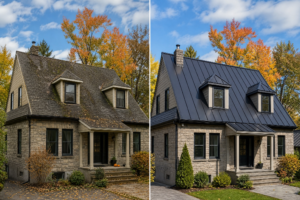
Asphalt shingles still dominate Quebec’s residential market. Their affordable price attracts homeowners on a tight budget. However, their environmental record poses a major problem.
A shingle roof lasts an average of 15 to 20 years in Quebec. As a result, a house built today will require three or four complete replacements. Each replacement generates between 2,000 and 4,000 pounds of waste per house. Yet this waste is practically never recycled in Quebec. It therefore ends up directly in landfills.
In addition, shingles are a petroleum product. Their manufacturing consumes non-renewable fossil resources. Transporting the raw materials also adds greenhouse gas emissions. When you add up manufacturing, transportation and disposal over 50 years, the carbon footprint of shingles becomes very heavy.
The recyclability of metal: zero waste at end of life
The environmental impact of a metal roof starts with a simple fact. Metal is 100% recyclable, indefinitely and without any loss of quality. In other words, when a metal roof reaches the end of its life after 50 years or more, it doesn’t end up in a dump. Instead, it goes back to the foundry to become a new product.
In fact, steel is the most recycled material in the world. It already contains between 25% and 35% recycled content when manufactured. This closed loop therefore considerably reduces the demand for virgin resources.
By comparison, asphalt shingles offer no viable recycling channel in Quebec. Every replacement creates permanent waste. In concrete terms, over 50 years, a single shingle roof can generate more than 10,000 pounds of waste. A metal roof, on the other hand, generates none. This difference is therefore massive and hard to dispute.
Lifespan: fewer replacements, less impact
The durability of metal is its most powerful environmental advantage. Indeed, a quality metal roof lasts between 50 and 70 years. Some metals, such as copper and zinc, even last more than 100 years.
Fewer replacements therefore mean fewer materials manufactured, transported and installed. They also mean fewer job sites and fewer trucks on the road. Indeed, every roof replacement requires considerable resources.
To illustrate the difference concretely:
- Shingles over 100 years: about 5 to 6 complete installations. This therefore represents 5 to 6 cycles of manufacturing, transportation, installation and disposal.
- Metal over 100 years: a single installation, followed by complete recycling at the end of its life.
In fact, Metal Roof Canada uses SSAB GreenCoat steel, manufactured to strict environmental standards. This material offers durability and weather resistance that extend its useful life to the maximum.

Energy efficiency: reducing your footprint every day
The environmental impact of a metal roof isn’t limited to the end of the product’s life. In reality, your roof influences your energy consumption every day. That’s exactly where metal makes a real difference.
Metal surfaces reflect a large portion of solar radiation. In summer, your attic therefore stays cooler than with dark shingles. Indeed, asphalt shingles can reach 70°C in full sun. They then transfer this heat into the house.
A light-coloured metal roof combined with good insulation therefore reduces the demand for air conditioning. In winter, this same insulation limits heat loss through the roof. As a result, you use less energy to heat and cool your home.
Using less energy also means producing fewer greenhouse gases. Every kilowatt-hour saved frees up capacity for other uses. In Quebec, even though hydroelectricity dominates, reducing consumption still benefits the shared grid. Learn more about energy-efficient roofs.
Compatibility with solar panels
A metal roof is the ideal surface for installing solar panels. This combination concretely strengthens the environmental impact of a metal roof even further.
Indeed, mounting systems for standing seams require no drilling. The clamps grip directly onto the metal ribs. No holes, no risk of leaks. The installation therefore remains clean and reversible.
In addition, the lifespan of a metal roof exceeds that of the solar panels. As a result, you’ll never have to remove your panels to replace the roof covering. With a shingle roof, however, this costly removal inevitably happens after 15 to 20 years.
By combining a metal roof and solar panels, you reduce your dependence on fossil fuels. You thus produce clean electricity while protecting your home. In short, it’s a doubly responsible approach.
Manufacturing: an impact worth putting into perspective
Let’s be transparent. Steel manufacturing consumes energy and produces CO2 emissions. This industrial process is therefore not environmentally neutral. In fact, it’s the main argument against metal.
However, this initial cost needs to be put into perspective. Indeed, the energy used to manufacture a single metal roof remains lower than that of three or four shingle roofs. A complete life cycle analysis therefore clearly favours metal.
In addition, the steel industry is evolving rapidly. Manufacturers in particular are adopting less energy-intensive processes every year. The SSAB steel used by Metal Roof Canada comes from European plants with very strict standards. In fact, according to a Natural Resources Canada report, improving the building envelope is one of the most effective ways to reduce residential carbon footprints.
Gutters and accessories: completing the cycle
However, an environmental approach doesn’t stop at the roof panels. Indeed, gutters, flashing and accessories also contribute to the overall footprint.
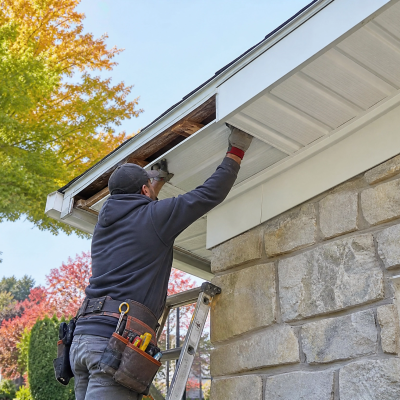
In particular, Metal Roof Canada offers steel gutters with a 50-year warranty. Like the roof panels, they are fully recyclable at the end of their life. They therefore eliminate the frequent replacements that vinyl gutters undergo.
An all-metal system thus maximizes the environmental consistency of your project. Every component lasts as long as the others. As a result, you don’t have to replace parts one by one over the decades. Ultimately, this approach reduces interventions, waste and costs over the entire lifespan.
Conclusion
The environmental impact of a metal roof stands out at every stage of its life cycle. Full recyclability, exceptional lifespan and energy efficiency make metal the most responsible choice. Asphalt shingles simply can’t compete on this front.
Choosing metal means investing only once and avoiding tonnes of waste. It also means reducing your energy consumption for decades.
Want to make a sustainable choice for your home? Request a quote from Metal Roof Canada and switch to metal for good.