Installing a metal roof over existing shingles is a question many homeowners ask their roofer. The idea is appealing: avoid removing the old shingles, save on labour and shorten the timeline. Indeed, it’s technically possible in some cases. However, it isn’t always the best option.
In this article, we explain when this approach works, when it causes problems and why most specialized roofers recommend complete removal instead. You’ll thus have all the information you need to make the right decision.
How it works in practice
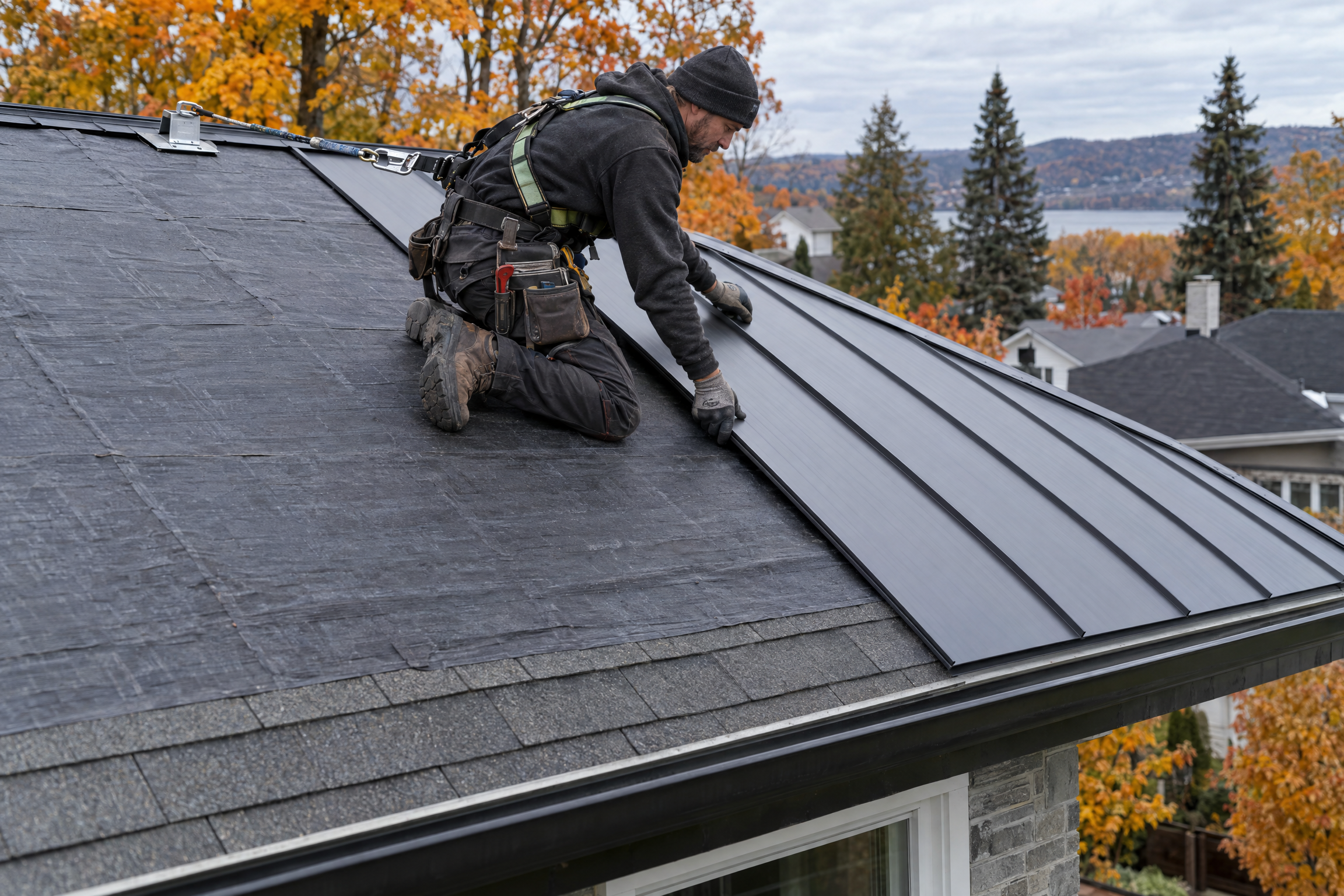
The principle is simple. Rather than removing the worn shingles, the contractor installs a system of battens or furring strips over them. These battens create a flat, even surface to which the metal panels are then fastened. The old shingles therefore remain in place under the new roof covering.
This method gained renewed popularity after the 1998 ice storm in Quebec. Insurance companies at the time paid for metal roofs to be installed directly over damaged shingles. It was then the fastest solution to protect thousands of homes.
Today, some contractors still offer this option. Indeed, it can save a few thousand dollars on the cost of removing and disposing of the old shingles. However, this short-term saving hides risks that every homeowner should know about before saying yes.
The advantages of leaving the shingles in place
Installing a metal roof over existing shingles has some real advantages. That’s why this option comes up so often in discussions.
- Savings on removal: removing the old shingles costs between $1 and $3 per square foot in labour and disposal fees. On a 1,200-square-foot home, that therefore represents between $1,200 and $3,600 in savings.
- Less waste: the old shingles don’t end up in the landfill. This is a concrete environmental benefit, especially since shingles are practically never recycled in Quebec.
- Faster job: without removal, the work moves faster. Your home is thus exposed to the elements for less time during the transition.
- Extra layer: the old shingles add a protective membrane between the deck and the metal panels.
These advantages are real, but they only tell part of the story. The associated risks deserve just as much attention.
The risks to understand
Most specialized metal roofers advise against installing over existing shingles. Their reasons are concrete and based on years of experience in Quebec.
The first risk is the inability to inspect the deck. When the shingles stay in place, no one can see the condition of the wood underneath. Rotten decking, weakened sections or mould remain hidden under the old roof covering. These problems then get worse silently for years under your new roof.
The second risk involves trapped moisture. Old shingles hold moisture, especially if they’re already damaged. When they’re covered with metal, this moisture can no longer evaporate. It therefore attacks the deck from the inside and speeds up its deterioration. As a result, your new roof sits on a base that’s deteriorating.
The third risk affects ventilation. Adding an extra layer changes the airflow in the attic. Inadequate ventilation creates condensation that damages the insulation and roof frame. In fact, it’s one of the most common reasons for warranty denials.
What the Construction Code says
In Quebec, the Construction Code limits the number of layers of roof covering. In general, a maximum of two layers is allowed. If your roof already has two layers of shingles, it’s therefore illegal to add a third.
In addition, some municipalities require complete removal when changing the type of material. Switching from shingles to metal may require a permit that requires removal. Check with your urban planning department before making your decision.
The Régie du bâtiment du Québec also recommends inspecting the deck during any roof replacement. This inspection is only possible if the old roof covering is removed. Going over the top eliminates this essential verification step.
What Metal Roof Canada recommends
Metal Roof Canada recommends complete removal of the existing shingles before installing a metal roof. This position is based on years of experience and a commitment to long-term quality.
By removing the shingles, the roofer can access the deck and inspect every section of wood. Rotten or weakened areas are replaced immediately. The installation therefore starts on a sound, verified base.
It’s also the ideal opportunity to improve the attic insulation and ventilation. These two elements directly influence the lifespan of your new roof. A metal roof installed on a new deck, with adequate insulation and ventilation that meets standards, will perform at its best for 50 years or more.
In addition, removal protects your manufacturer’s warranty. The 50-year non-prorated warranty on SSAB GreenCoat steel requires an installation that complies with the manufacturer’s specifications. Installing over existing shingles may compromise this coverage. It’s a risk that saving a few thousand dollars doesn’t justify.
The exception: when it’s acceptable
In some specific cases, installing over shingles can be considered. The shingles must then be in good overall condition, with only one layer in place. The deck underneath must also be recent and sound.
In concrete terms, this approach may be suitable if your shingles are less than 10 years old, show no bumps, cracks or rot, and if your attic is well ventilated. An experienced roofer can assess these conditions and give you an honest opinion.
However, even in these favourable situations, the result will always be inferior to an installation on a bare deck. You’re accepting a compromise in exchange for a saving. So make sure you fully understand what you’re giving up before choosing this option.
The real cost of each option
The price difference between the two approaches is smaller than you might think. Here’s a comparison for a 1,200-square-foot home.
- With shingle removal: add between $1,200 and $3,600 to the total cost for removing, transporting and disposing of the old shingles.
- Without removal: you save this amount, but you add the cost of the support battens, about $800 to $1,500.
The net saving is therefore between $400 and $2,100. In return, you give up the deck inspection, you risk moisture problems and you may compromise your warranty. On a total investment of $25,000 or more, this saving represents less than 10%. That’s a small percentage for a significant risk.
Conclusion
Installing a metal roof over existing shingles is technically possible, but rarely the best decision. The saving is modest and the risks are real. An uninspected deck, trapped moisture and a compromised warranty aren’t worth saving a few hundred dollars.
Investing in complete removal gives you a roof installed by the book, on a verified base and with a fully valid warranty. It’s the difference between a roof that lasts 30 years and one that lasts 50.
Torn between the two options? Contact Metal Roof Canada for an honest assessment of your situation and a quote tailored to your project.